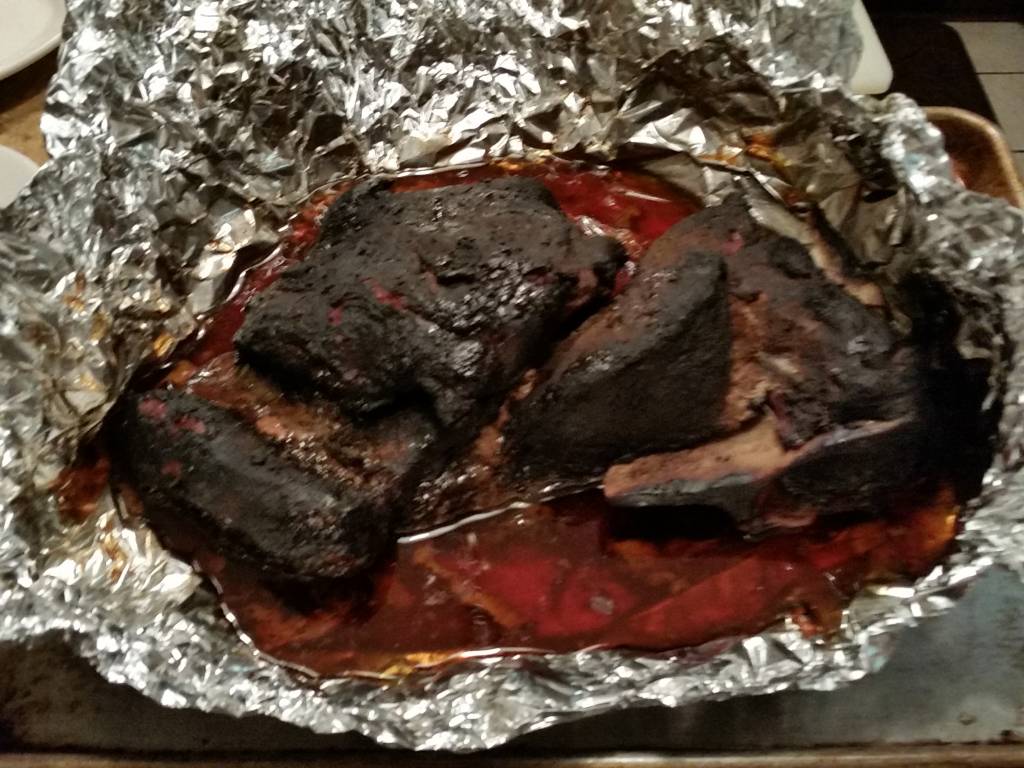
3-bone Pork Rib Roast Smoked

This roast has potential to be great.

10/22/2016

When the Pork Shoulder Competition Trimmed meat came off the Weber today there was still a couple hours of charcoal to burn. So, we had defrosted the 5″ long, 3-rib pork roast and decided to throw it on. 20161023_053849Cold from the refer we removed it from the vac sealed bag, removed the silver skin, and rubbed in separately and liberally with:

  • Yellow mustard then:
  • granulated garlic
  • cracked black pepper
  • broken rosemary and
  • thyme

3:30 – Put it on the Weber at 225 after the butt was pulled and the coals stoked with a new pecan chunk.

4:30 – The grate temp is steady at 225.

6:00 – Grate temp is 242 and TBS. IT is 242.3-Bone Pork Roast

7:30 – IT is 168. Wrapped and put into convection over at 300.

7:50 – It is 167 and grate is 197. Pulled and wrapped in alum foil to cool and when reheated Mary says it will be fine.

10/26/2016 – Reheated in oven at 275 wrapped on top and side in foil and sitting on 1/4 sheet pan. Cut into three chops and it was good. Not to die for but good. A spicier rub might have helped along with misting it or maybe bacon wrapped.

Pork Shoulder “Competition” Trimmed

First time trimming the butt into muscle groups to create more bark and surfaces to season. Turned out great in the Weber Kettle.

Saturday, October 22, 2016. Temperature starts in high 60s and in high 70s at the end. Humidity is in 39% as the first cool front blew through Thursday.

6:00 AM – Trimmed an 8.3 lb pork shoulder to expose the Money Muscle, Horn and center for pulled pork as learned from here. Shook on evenly Stubbs Hot Pork Rub on all surfaces and put back into refer in bowl under plastic wrap.

First Competition Trim

First Competition Trim

11:00 – Put trimmed butt into smoked in the Weber Kettle with the SnS and my new Drip ‘N Griddle pan by Adrenaline Barbecue Co. Used Kingsford Blue Bag with pecan chunks from the farm. Initial temp with Thermoworks air probe–mounted with the grate clip between the meat and kettle opposite the fire–was 170 so opened up upper and lower vent to get it up. By 11:15 temp is in the 220s.

1:00 – Temp has been steady around 230. Basted with ACV+water about 2:1 as looks dry. Coals in SnS are about 1/2 burned.

3:30 – Pulled it with an IT of 133-138 that was surprisingly even despite the widely different sizes of the connected pieces. Wrapped in foil on a 1/4 sheet pan, poured the drippings over it and put  into convection over set to 300.

After time in oven

After time in oven

6:30 – IT was around 205-215 and falling apart. The Money Muscle tasted good but collapsed into pieces. The larger rubbed and smoked surface area was a great addition to the finished product. There was still plenty of drippings caught in an aluminum pan but there was not globs of cooked fat to throw away.

NEXT TIME – Trim the butt as done here and set the temp probe before wrapping to be sure it is position to give a good reading so it is overcooked.


MES Heat Distribution Notes

4/30/2016 – Modified one end of a small cookie sheet to allow the door to close and fit snugly as a baffle above the chip box and to shield the box probe on back wall and direct heat to center of chamber. Set the two ChefAlarm probes so the ends were about 3″ from the side walls on the 2nd rack. During warm up the probe over the chip box read ~20° more than the box probe and ~30° more than the probe on the other end of the same grate. As the box and internals warmed up and settle down the three readings came together within 5°. But, when the coil came on the one over the coil would climb higher but then come back down. The cookie sheet shield caused the box probe to be the slowest responding and that seemed to help.

10/1/2016 – MES temp is 153 and at door is 133 after 30 min without opening door. Reset MES to 170 and 30 min later MES is showing 179 (coasted up there) but near door on left side is 159. Again, 20 degrees different at the same grate.

10/8/2016 – MES was set at 230 and the air probe in the left front area on the third rack down read in the 215-220 range.

10/16/2016 –20161016_172549  When smoking a small amount of jerky hanging on bamboo skewers from the top grate and with a drip pan on the bottom grate there was a difference in temps of about 15 degrees between the box thermo in the back wall near the third grate from the top and the two Chefworks probes hanging under the top grate after it stabilized. Initially, pre-stabilization, it was 20+ difference. The drip pan was a couple inches off center to the right or heating element side. The chip loader was pulled out so the half open area where load chips was outside the MES about 1″.

Creole Sauce & Uses at NOLA Cuisine ToTry

Click for his CREOLE SAUCE RECIPE

A VARIETY OF USES FOR CREOLE SAUCE

Catfish Courtbouillon (COO-B-yawn) Creole Sauce made with Dark Roux and Seafood stock. Simmer the sauce with 4-5 lemon slices, add Catfish cut into 1 1/2 inch pieces. For my small recipe I would use about an 8-10 oz. Piece of Catfish. Serve over Creole Boiled Rice.

Grillades & Grits (GREE-yahds) Creole Sauce made with dark roux and beef, veal or pork stock. I use Round Steak 1 lb. cut into 2 inch squares about 1/2 inch thick. Dredge the Grillades in flour mixed with Creole seasoning. Heat about 3 Tbsp. Vegetable Oil in a dutch oven until almost smoking, brown them very well (in batches if necessary). Cover the Grillades with Creole Sauce, add a little water or beef stock to make it slightly thin, the sauce will reduce while cooking. Simmer for about 2 hours or until the meat is very tender. Serve over Grits.

Sauce Piquant This is a Cajun sauce which can contain almost any varmint imaginable. Alligator, Turtle, Squirrel, Rabbit, Shrimp, Chicken, Crawfish, et cetera. This is basically Creole sauce which is very, very hot; which makes it a Cajun Sauce. I would add about 1/4 cup hot peppers (Jalapenos if they’re hot ones (they’re not as hot as they used to be), or Serranos) for my small Creole Sauce recipe. Make it with a comparable stock to the main ingredient. Make it similar to the Courtbouillon. I don’t usually use a thickening agent for this sauce, if I do its a Dark Roux. Serve this dish over rice.

Shrimp Creole Make your Creole Sauce with Shrimp stock. If you’re fortunate enough to be able to find heads on shrimp, do so. Simmer the shrimp (about a pound) in the sauce until just cooked through, serve immediately over rice with plenty of sauce.

All credit for the above goes to http://www.nolacuisine.com/2005/07/26/uses-for-creole-sauce/

Rendering Pork Fat

How To Render Fat To Make Lard

You will need a pot or Dutch oven.
Pre-heat oven to 250º regular oven 225º convection oven.

Place 5+ pounds of ground pig fat into a covered oven-safe dutch oven.
Bake at 250º regular oven 225º convection oven, stirring occasionally for about an hour or so. Most of the solid should have turned to liquid by then. Be careful that the ground fat doesn’t turn brown in color.
Ladle out the liquid and strain through coffee filters layered in a metal strainer.
Put any strained solids back into the dutch oven.
Let the lard cool to about 100 degrees, and portion them into plastic soup containers or silicone bakeware.
Put in freezer until completely cool and solidified.
Leave headspace, as the lard will expand in volume as it cools.
Turn out onto a cutting board and slice into usable pieces.

From http://www.annsentitledlife.com/recipes/how-to-render-fat-to-make-lard/

Chicken Buttermilk Brine ToTry

Gary Wiviott’s buttermilk brine –

  • 1/2 gal buttermilk,
  • 1 cup warm water,
  • 2/3 cup kosher salt,
  • 1/2 cup brown sugar,
  • 1/4 cup Old Bay Hot (Gary recommends just regular Old Bay tho’)
  • OPs modifications:  Sometimes we toss in some cut-up onions, celery, carrots, and some rosemary and thyme.  The fancies are usually added for more special occasions and we find that they work best if we mix the brine up a day early to let it mature for a day before putting the chicken in.  We brine chickens for around 12 hours.  Works on Thanksgiving turkeys too, except we give them an extra day.

The above was in post by Brian who responded with more as pasted below.

Those down south know all about buttermilk brines.  I once tried plain buttermilk and it didn’t work nearly as well as the basic brine mixture above (1/2 gal buttermilk, 1 cup warm water, 2/3 cup kosher salt, 1/2 cup brown sugar).  Even though the plain buttermilk is acidic enough, it doesn’t soak in and do it’s magic without the salt, sugar, and water to thin it down a wee bit.  Note that this amount of brine is for TWO chickens (halved, pieces, whatever).  Make just a half batch for one chicken.  I just use gallon Ziploc bags, one chicken each, for brining.

The brine by itself doesn’t add flavor so much as it tenderizes the meat and lets the natural chicken flavor out.  The spice that’s added only seems to be detectable in the chicken if you let the spices leach into the brine for a day …and the same applies to the herbs and veggies.  Some people simmer the herbs in the water for 10-15 minutes to bring out their flavor.  Some people add cut up carrots too …but I don’t think they add much.  If you DO add these other ingredients and let them soak in the brine for a day, then the chicken for a half-day in the ‘matured’ brine mixture …then the good flavors of all the above go clear down to the bone AND the chicken is made super tender and has great mouth feel.  It’s my favorite brine…. suitable for all ways of cooking chicken.

I do recommend buying Gary Wiviott’s book …he’s got an “my way or no way” attitude and I think his instructions for using a plain Weber Kettle are way off in terms of heat management, but you can’t argue with his results when followed for a WSM or offset smoker.  His book was my intro to low and slow, and for the entire first year of cooking this way, I did it all in a Weber Kettle …and boy did that experience make me appreciate my WSM!

Myron Mason ….can’t recommend this guy.  High on ego, short on brainz (sorry if that offends), can’t quit referring to his hind quarters… I threw his book away.

Brian

Buttermilk Ranch Dressing

By Ina Garten – Very good

Ingredients:

  • 3 scallions, white and green parts, chopped
  • 1/2 cup chopped fresh basil leaves, lightly packed
  • 2 tablespoons freshly squeezed lemon juice
  • 11/2 tablespoons Dijon mustard
  • 1 tablespoon good olive oil
  • 2 garlic cloves, chopped
  • 2 1/2 teaspoons kosher salt
  • 1 teaspoon freshly ground black pepper
  • 1 cup good mayonnaise
  • 1/2 cup Greek-style yogurt, such as Fage Total
  • 1/2 cup buttermilk, shaken
  • 1 red onion, sliced

Directions:

Place the scallions, basil, lemon juice, mustard, olive oil, garlic, salt, and pepper in the bowl of a food processor fitted with the steel blade. Puree for 15 to 20 seconds to make a smooth mixture. Add the mayonnaise, yogurt, and buttermilk and blend until smooth. Transfer the dressing to a container, cover, and refrigerate for 1 hour for the flavors to develop.