Tasso Recipes ToTry

By Chef JJ here edited slightly by me.

Put half in with the cure/brine. Once cured rub the other half on the well-dried pork before smoking. This anticipates the cure/brine having a good salt level as there is none here. It also is for 5 lbs of pork shoulder cut into small strips.

4T Black Pepper
4T White Pepper
4T Paprika
4T Gran Garlic
4T Gran Onion
4T Mustard Pwd.
2tsp Dry Thyme
2tsp Dry Oregano
2tsp Cayenne Pepper

He added:  “BTW if you add 4T Kosher salt to that Recipe it makes a Killer Blackening Spice, Add 1 Cup Raw Sugar along with the salt and you got a great Pork and Poultry Rub. I left the Salt and Sugar out because it’s in Pop’s Brine already”

Someone else said they pound the seasoning in with a tenderizing hammer.


Nepas at SMF said the recipe at Nola Cuisine is good.

http://www.nolacuisine.com/2005/11/03/homemade-tasso-recipe/

Credit for all below goes to NolaCuisine.com

A few Tips:
“After seasoning it, I recommend keeping it in the fridge, at least 3 days to let it cure, look at how nice and pink the center is.”

“Here is my recipe for Tasso. I used a Boneless Pork Roast cut into about 4-5 inch long, 1/2 to 1 inch thick slices. This is seasoning for about 5 lbs of pork:”

Homemade Tasso Recipe

5 lbs Pork cut as described above
Seasoning:

3 Tbsp Kosher Salt
2 Tsp Cayenne or To Taste (see above)
4 Tbsp Paprika
2 Tbsp Fresh Garlic, minced
2 Tbsp Coarsely Ground Black Pepper
1 tsp Cinnamon
1 Tbsp White Pepper
1 Tbsp Brown Sugar

“Mix the seasoning together well. Rub the seasoning into the meat, you want a lot on there, call it 1/8 inch, use it all. Place on a plate or tray, cover and refrigerate 3 days.”

“Before smoking put the Tasso on an elevated rack so that air can circulate around it, then put a fan on it for about 2 hours to dry it out. I also don’t use a water pan when smoking Tasso, this is something that I actually want to dry out during the smoking process.”

“I hot smoked this batch in an inexpensive upright barrel smoker using charcoal as the heat source (heated with a chimney starter, no lighter fluid or matchlight coals please.) I used Pecan chips that were soaked in water for 1 hour for the smoke. I smoked this a total of about 4 hours, the first 2 hours at about 150-160 degrees F. The second two hours at 180-190 degrees F. The object is to get as much smoke into the meat, before cooking it all the way through. I brought the internal temperature of the meat to 150 degrees F in the last 2 hours of smoking. When finished I again put the Tasso in front of a fan for about 1 hour. Refrigerate. When completely cold portion and store the Tasso in vacuum sealed packages. Freeze.”

Makes 5 lbs of Tasso


PAUL PRUDHOMME`S TASSO SEASONING

Five pounds tasso
Standing time: 3 days
Smoking time: 4 to 12 hours

1 tablespoon plus 1 teaspoon salt = 18.1 + 6.03 = 24 gm
1 tablespoon plus 2 teaspoons sugar = 15.9 + 2 x 5.3 = 26 gm
4 tablespoons black pepper = 4 x 7.62 = 30 gm
2 tablespoons plus 1 teaspoon white pepper = 2 x 7.36 + 2.45 = 17 gm
2 tablespoons plus 1 1/4 teaspoons ground red pepper (preferably cayenne) = 2 x 7.6 + 1.25  x 2.53 = 18 gm
3 tablespoons garlic powder = 3 x 8.34 = 25 gm
2 tablespoons plus 1 teaspoon onion powder 2 x 8.19 + 1 x 2.73 = 22  gm
2 tablespoons plus 1 3/4 teaspoons cumin = 2 x 5.88 + 1 x 1.96 = 14 gm
2 tablespoons plus 2 1/2 teaspoons paprika = 2x 6.78 + 2.5 x 2.26 = 19 gm
1 tablespoon plus 2 1/4 teaspoons gumbo file powder (optional) = 1 x 5.8 + 2.25 x 1.93 = 10 gm
5 pounds boneless pickled pork butt, see text above

1. Mix all ingredients, except pork butt, together.

2. Dry the pork butt off with a paper towel. Roll the pork in the seasoning mix, coating the meat completely, and pat it in well. Let the seasoned meat sit in the refrigerator covered for 3 days.

3. After the 3 days, smoke it to an internal temperature of 165 degrees. I smoked two pieces in my smoker with hickory chips for about 12 hours. Another two pieces I smoked in the oven of my electric range, using liquid smoke. They came out great both ways.

From Turning Pork Butt Into Tasso Is An Old Cajun TrickMay 16, 1985, by Merle Ellis.


Romeo Nadeau, Tasso Maker

Pat Baldridge, a great cook and food editor of the State Times-Morning Advocate in Baton Rouge, put me in touch with Romeo Nadeau, who, she says, “makes one of the best tassos in Louisiana.” I called him:

“There are about as many recipes for tasso in this part of the country as there are Cajuns, but I’ll be happy to tell you how I make mine,” he said. “I use Boston butts, pork shoulder butts, cut into strips about 1 1/2 to 1 3/4 inches thick. I put the meat down in a pickle made of 2-1/2 gallons of ice water, 2-1/2 pounds of salt, 1/2 pound of sugar and 1/2 pound of cure for every 50 pounds of meat. Let it set in that cure in the cooler for a couple of days. It won’t need to cure any longer because you’ve cut the meat in strips and the cure penetrates pretty fast.

“When you take the meat out of the pickle, rinse it good, let it dry a bit, then sprinkle it good with granulated garlic and rub that in. Then cover that sucker with cayenne pepper till it won’t take no more. Don’t rub the pepper in–just pat it on real heavy. When it won’t take no more, let it stand for about an hour at room temperature till it gets kind of tacky to the touch.

“Put the meat in the smokehouse and let it set for an hour at 135 degrees with the damper open. Then close the damper down to 1/4 open, kick the temperature up to 175 degrees and pour the smoke to it till the internal temperature of the meat reaches 150 degrees. That’s all there is to tasso.”

Found at http://articles.latimes.com/1985-05-23/food/fo-8336_1_pork by Merle Ellis. That was the same text as published in the Chicago Tribune linked on this page.


For Lynn Poli’s cajun tasso recipe click here.

Senate BBQ Sauce

This recipe was found in a magazine article pre-1995.

Ingredients

  • 3 C Water
  • 1 C Tomato Catsup
  • 1 6-oz can tomato paste
  • 1/4 C vinegar
  • 1 t sugar
  • 2 t chili powder
  • 1 t salt
  • 1 t black pepper
  • 2 t paprika
  • 2 cloves garlic minced
  • 2 bay leaves
  • 2 T minced onions
  • 2 T Worcestershire Sauce
  • 2 T butter
  • 2 T oil
  • 1/2 lemon, juice and rind

Combine. Bring to boil, reduce heat and simmer for 20 minutes.

By Clayton Baird


10/30/2016 – Made a batch and had a quart when complete. Vinegar was a bit much although after it ages some we’ll see. Maybe should have used ACV. Don’t recall bringing it to a boil so that might have been why the vinegar was strong.


White Yeast Cornbread

Ingredients

1/4 cup butter or margarine
1 cup white corn meal
1 cup all-purpose flour
1 envelope Fleischmann’s® RapidRise Yeast
1/4 cup sugar
2 teaspoons Argo® Baking Powder
1/2 teaspoon salt
2-1/2 cups very warm buttermilk (120° to 130°F)
1 egg

Optional from original receipe at Fleischmann’s Breadworld site at http://www.breadworld.com/recipes/White-Cornbread-with-Chilies

1/2 cup finely chopped hot banana peppers
1/4 cup finely chopped onion

Directions

Melt butter in a 10-inch heavy cast iron skillet over low heat. Rotate the skillet slightly to coat the sides. Set aside.

Combine corn meal, flour, undissolved yeast, sugar, baking powder and salt in a large bowl. Add buttermilk, egg, peppers and onion; stir until well mixed. Pour into skillet.

Cover the skillet and let rise in a warm, draft-free place for 30 minutes or until almost doubled.

Preheat oven to 350°F. Bake the bread for 30 minutes or until a toothpick inserted in the center comes out clean.


9/25/2016 – Made per the recipe but did not add the onions or peppers. It turned out heavy and very moist without much flavor. Don’t remember warming the buttermilk and maybe that is why it did not rise much.

Curing Parameters

From Martin, aka DigginDogFarm, at SMF. All below before the dividing line are from comments in the post here. IMHO these are the most concise statements of equilibrium curing.

…equilibrium brining, below is a brief description that I wrote up.
Equilibrium brining is a method of brining that makes it impossible to over-salt or over-cure meat when using a reasonable percentage of salt and the proper amount of cure. In equilibrium brining the submerged meat and the cover brine (or cover brine and injected brine, in larger pieces of meat) act as a single system and are considered a single unit when calculating salt, sugar and cure amounts. Over time, the ingredients in the brine migrate into the meat until levels in the meat tissue and in the brine are balanced via osmosis and diffusion. Therefore, the calculation for ingoing salt, sugar and cure is based on the weight of the meat plus the weight of the water or other liquid used in the brine.

The calculator is only good for recipes using cure, and in the case of brining, an equilibrium brine. Equilibrium brining takes time and the ingredients are often less than what’s used in a typical brine.
Larger pieces of meat should be injected, and a high ratio of meat to liquid (4:1,2:1, etc.) should be used for best results.

Here’s an example of a 2:1 ratio (meat:water) equilibrium brining project. We’ll do immersion cured (rind-off) bacon which requires no more than 120ppm nitrite.

Our piece of bacon weighs 1000grams so the amount of water required for our 2:1 brine is 500grams, adding the two together we get 1500grams.
We now calculate the cure, salt and sugar for a total of 1500 grams of meat and water.
Our bacon is less than 2-1/2 inches thick so injecting isn’t required.


Re: Immersion Cure – For a good discussion about the assumed or government established uptake rate go this post and comments.


From Pop’s here – “Per gallon maximum equates to 3.84 oz. per gallon of water.  One ounce is approximately a heaping tablespoon by my scale, a level tablespoon is .88 oz.  So, 1 tablespoon per gallon of water is a fair measurement that will not toxify the meat or even come close.  I have zero chemical analyses to back this up; it is common sense and proven that it will cure the meat effectively and no, don’t have the ppm or anything else.  It is safe, it works, that’s all I need to know.

I do add additional ingredients; i.e. plain salt and sugars or sugar substitutes, but this is in addition to the cure concentration, not in conjunction with it and not affecting the concentration levels.  I first put in the curing salt, then add the water by gallon measurement, then add the additional ingredients.  These are to your taste preference.”


In response to a post about concern for sugar in Brines and Cures the consensus was that it is not included for safety–only taste. Dave O said “For controlling the amount of sugar and carbs…  use cure #1…  I add 1% sugar to my curing stuff…  if you eat a pound of meat, there is only 4.5 grams of sugar in that pound at 1% sugar….” See http://www.smokingmeatforums.com/t/257067/sugar-free-curing#post_1652401


See http://www.smokingmeatforums.com/t/253691/seasoning-after-curing-and-before-smoking/40 with debate between two posters that includes the advice below.

Q:  I also bought a whole boneless pork loin for some canadian bacon.   Can I use the same dry cure that I have mixed for my canadian bacon as what I do for my belly bacon?   And is it the same cure/weight ratio or different?  A: by Dave O. –  Yep…  Same ratios, same cure mix…  If you like it, try it…    If your mix adds about 1.1 grams [of Cure #1] per pound or 1 tsp. per 5#’s, it can be used for anything you want to smoke…  You can tweak it for different meats by adding spices etc. and there’s no need to adjust the mix..   weigh out the proper amount of mix for each piece of meat, add the spices and you are good to go…


A great site with videos about the three types of curing.  https://stellaculinary.com/cooking-videos/food-science-101/fs-002-science-behind-brining-four-part-video-lecture


About Martin’s (DigginDogFarm at SMF) cure calculator and emersion and dry curing process here http://www.smokingmeatforums.com/t/124590/universal-cure-calculator  Extracts from his posts are below. Note this is a largely a repeat from above but worth repeating.

  1. Equilibrium brining, below is a brief description that he wrote up.”Equilibrium brining is a method of brining that makes it impossible to over-salt or over-cure meat when using a reasonable percentage of salt and the proper amount of cure. In equilibrium brining the submerged meat and the cover brine (or cover brine and injected brine, in larger pieces of meat) act as a single system and are considered a single unit when calculating salt, sugar and cure amounts. Over time, the ingredients in the brine migrate into the meat until levels in the meat tissue and in the brine are balanced via osmosis and diffusion. Therefore, the calculation for ingoing salt, sugar and cure is based on the weight of the meat plus the weight of the water or other liquid used in the brine.”
  2. “The calculator is only good for recipes using cure, and in the case of brining, an equilibrium brine. Equilibrium brining takes time and the ingredients are often less than what’s used in a typical brine. Larger pieces of meat should be injected, and a high ratio of meat to liquid (4:1,2:1, etc.) should be used for best results.”
  3. “Here’s an example of a 2:1 ratio (meat:water) equilibrium brining project. We’ll do immersion cured (rind-off) bacon which requires no more than 120ppm nitrite. Our piece of bacon weighs 1000grams so the amount of water required for our 2:1 brine is 500grams, adding the two together we get 1500grams. We now calculate the cure, salt and sugar for a total of 1500 grams of meat and water. Our bacon is less than 2-1/2 inches thick so injecting isn’t required.”
  4. “Nitrite limits can be found in the USDA’s Processing Inspectors’ Calculations Handbook at www.fsis.usda.gov/OPPDE/rdad/FSISDirectives/7620-3.pdf   Please be sure that you understand the technical and safety issues involved. It’s especially important to understand what’s meant by ‘dry cured’ in the handbook, the associated ppm numbers do not apply to short-term curing.”

From Chef JimmyJ “…the fatal dose of sodium nitrite is in the range of 22 to 23 milligrams per kilogram of body weight. To obtain 22 milligrams of sodium nitrite per kilogram of body weight (a lethal dose), a 154-pound adult would have to consume, at once, 18.57 pounds of cured meat product containing 200 ppm sodium nitrite (because nitrite is rapidly converted to nitric oxide during the curing process, the 18.57 pound figure should be tripled at least). Even if a person could eat that amount of cured meat, salt, not nitrite, probably would be the toxic factor.”

In another post he responded to the question of how long to cure pork belly “Most go by 7 days per inch thickness.”


Chef JimmyJ – There is a lot of opinion on Cure #2 amounts. At the amounts used most frequently, 1tsp/5Lb, even doubling is still well under toxic level.

Dave Omak – “Cure #1 is added at a rate of 1 tsp. per 5#’s of stuff…  or 1.1 grams per lb….   That includes water etc…   Sooo, if you have 5#’s of meat, 2#’s of water 2 oz. of salt, 1 oz. of sugar…….  That’s close to 7.5#’s of stuff so add 1.5 tsp. of cure #1…..    Ppm is based on weight units…  It’s much easier to convert weights to grams…   using a 0-100 grams range electronic scale is a really good way to get measurements accurate….  even helps when adding spices etc. for reproducibility…..The time for stuff to sit in a curing solution is 7 days per inch thickness…   over 2″ thick, it’s best to also inject to get a uniform distribution

Dave responded later to the same thread.

FWIW, USDA / FDA recommends for commercial processors, when brining, injecting, massaging bacon in a wet brine, 120 ppm is the max allowable nitrite for that curing system.  When using a “dry brine” rub style cure for bacon, 200 ppm is the max allowable nitrite for that curing method…..  It is also suggested, somewhere in the regs., that 120 ppm nitrite be “considered” the lowest amount of nitrite to use when curing meats.

Then we have the nitrite dissipation.

Prague Powder #1 – Also called Insta-Cure and Modern Cure. Cures are used to prevent meats from spoiling when being cooked or smoked at low temperatures (under 200 degrees F). This cure is 1 part sodium nitrite (6.25%) and 16 parts salt (93.75%) and are combined and crystallized to assure even distribution. As the meat temperate rises during processing, the sodium nitrite changes to nitric oxide and starts to ‘gas out’ at about 130 degrees F. After the smoking /cooking process is complete only about 10-20% of the original nitrite remains. As the product is stored and later reheated for consumption, the decline of nitrite continues. 4 ounces of Prague powder #1 is required to cure 100 lbs of meat. A more typical measurement for home use is 1 level tsp per 5 lbs of meat. Mix with cold water, then mix into meat like you would mix seasonings into meat.”

“The last sentence may seem a bit confusing…  My understanding is….  they are mixing comminuted [ground] meats..  add a bit of water to further the homogenous mix of all the ingredients does not dilute the nitrite …   because….  the water evaporates and the correct amount of nitrite is left behind to cure the product….   That is the same premise I use when I inject cure stuff like hams, loins, etc.. “

Another response by Dave “…generally whether it be cure #1 or #2, 2.5 grams of either per Kg is recommended..”


Just for an idea of what the differences are:

Prague powder #1 is a mixture of 1 part sodium nitrite and 16 parts salt. You normally use 1 level teaspoon of cure for 5 lb. of meat. Used at any time meat is not immediately put into freezer or refrigerator, Such as smoking, air drying, dehumidifying, etc. This is similar to and sometimes called Curing Salt.

Prague powder #2 is a mixture of 1 part sodium nitrite,.64 parts sodium nitrate and 16 parts salt. You normally use 1 level teaspoon of cure for 5 lb. of meat. mainly used for products that will be air cured for long time like: Country Ham, salami, pepperoni, and other dry sausages.

Instacure 1 is a mixture of 1oz of Sodium Nitrite (6.25 %) to 1 lb of salt. Used at any time meat is not immediately put into freezer or refrigerator, Such as smoking, air drying, dehumidifying, etc.

Instacure 2 is a mixture of 1 oz of Sodium Nitrite (6.25 %) along with .64 oz od Sodium Nitrate (4 %) to 1 lb of salt. mainly used for products that will be air cured for long time like: Country Ham, salami, pepperoni, and other dry sausages.

Note: The Curing Salts above contain FDA approved red coloring agent that gives them a slight pink color thus eliminating any possible confusion with common salt

Morton’s Tender Quick is a mixture of salt, sodium nitrite, sodium nitrate and sugar. You normally use 1 level tablespoon of cure for 1 lb. of meat.

Saltpeter is potassium nitrate and is also used as a curing agent but I know – DeejayDebi


The part I always remember:

One ounce of Cure #1 dry cures 25 pounds of meat, if evenly distributed over all sides of those 25 pounds of meat.

One ounce of “Tender Quick” dry cures 2 pounds of meat, if evenly distributed over all sides of those 2 pounds of meat.

The length of time for this curing depends on the thickness of the meat to be cured.

Bear


Re: Morton Tender Quick

Morton TQ Recipes at the Morton website – click here.

From SMF Bearcarver says that TQ recipes say:

  • One is using 1 TBS of TQ per pound of meat, soaking for 1 or 2 hours.
  • The other is using 1.5 tsp of TQ per pound of meat, and soaking overnight.
  • Anytime I use TQ for anything, I never add any salt—-There is generally the right amount in the TQ itself.

For Bear’s Jerky recipe with TC click here.

DirtSailor says: Why not use cure #1? Takes out the salt factor. At a ratio of 1 teaspoon per 5 pounds of meat a pound of cure goes a long way. If I used TQ with my Thai Jerky recipe it would be way too salty. The soy sauce and the fish sauce mixed with TQ wouldn’t work. That’s why I prefer using cure #1 for jerky is I can use other salty flavors.

TQ in Jerky by SQWIBS – http://www.smokingmeatforums.com/t/174131/sqwibs-jerky-recipes


Forum member asked about curing jerky. Chef JJ said in several responses to the same post here  — 1-2% salt based on meat’s weight, cure and any liquid that will help dissolve it. Everything else is your choice. Liquid as needed to enrobe the meat and distribute the flavors. 5lb of Beef = 0.8 to 1.6 oz salt. You are just getting the meat wet to distribute the ingredients evenly.


From DiggingDogFarm January 15, 2015, at Smokin-It.com

Here’s how an immersion brine is checked for safety (it’s important to remember that only a portion of the cure is absorbed into the meat.)

Weight of the Nitrite x Percentage of Brine Pick-Up x 1,000,000 ÷ Total Weight of the Brine = PPM Nitrite

4 teaspoons Morton’s Kosher Salt (19 grams)
1 teaspoon Prague Powder #1 (5 grams)
3 tablespoons Dark Brown Sugar (45 grams)
1 cup Warm Water (237 grams)

Weight of the Nitrite… 5 grams of Cure #1 x 6.25%=.3125 gram Nitrite
Total Weight of the Brine=306 grams

At 10% Pick-Up….
.3125 x 10% x 1,000,000=31250
31250÷306=102 PPM Nitrite

At 15% Pick-Up….
.3125 x 15% x 1,000,000=46875
46875÷306=153 PPM Nitrite

It may not even hit 10% pick-up.

Well within the 200PPM government limit used by many folks as a measure of safety.

Smoked Asparagus – ToTry

From .org, June 24, 2016

Ingredients

2 tablespoons butter
4 cloves garlic, sliced thin
2 tablespoons lemon juice
salt to taste
1/4 teaspoon ground black pepper
1 onion, thinly sliced
1 1/2 pounds asparagus, trimmed

Directions

Preheat Smoker to 240 degrees

In a small saucepan, melt the butter, stir in the garlic and cook over low heat for 10 minutes. Remove from the heat and mix in the lemon juice, salt, and black pepper.
Arrange the onions in the bottom of a large cast iron skillet. Place asparagus spears over the onions. Drizzle the butter and garlic mixture over the asparagus. Place the uncovered skillet on the grill of your preheated smoker. Close the smoker and cook the asparagus until tender, which is about 1 hour.

Tasso our way first time

August 28, 2016

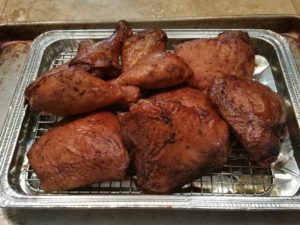
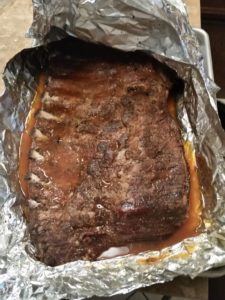
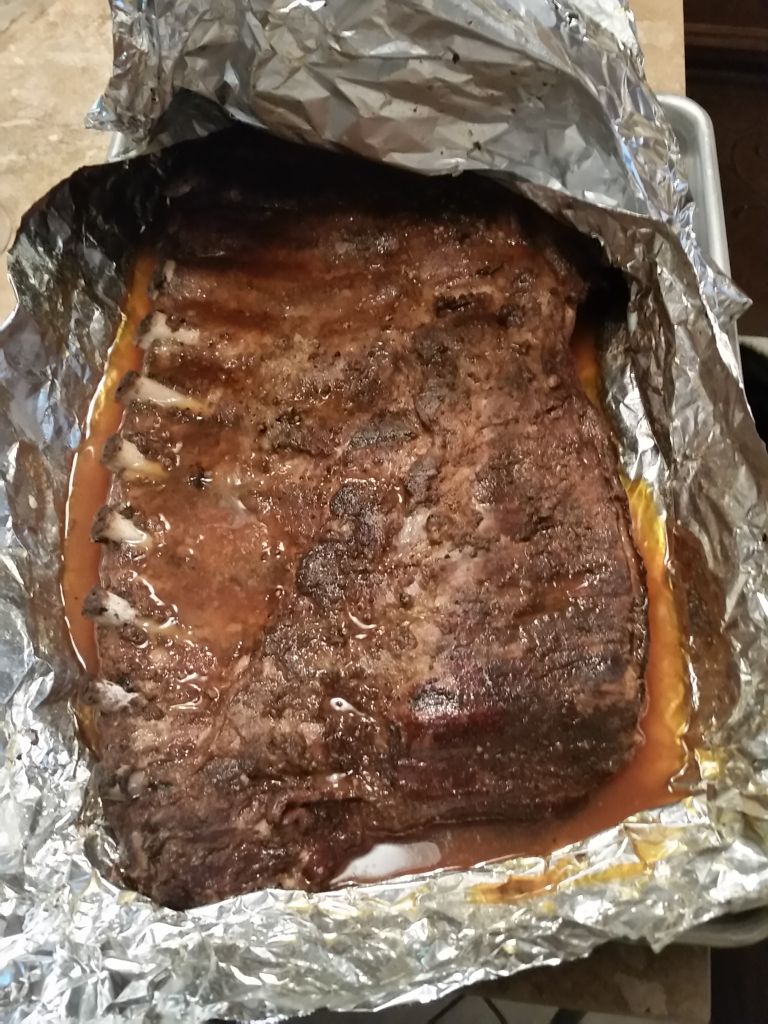
This was a sideline effort to the larger effort of smoking two racks of spare ribs. Trimmed the racks of the flaps and the tips along with other loose pieces. Trimmed the heavy fat off of the trimmings and rubbed them good with Stubb’s Hot Pork Rub.20160828_160948

Put them into the MES on the grills beside the spares next to the door. The MES was set to 230° and the smoke was from Traeger’s Hickory Pellets. They smoked for about 3 hours as I pulled them when the ribs were wrapped.

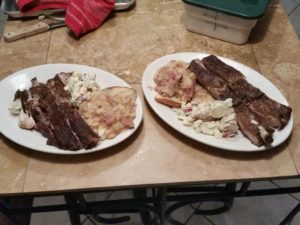
Sliced small pieces while it was hot and we were both very impressed and will intentionally trim more next time to make a lot for flavoring other dishes.

The pieces were more moist than what we bought in LA. But, those were cold so need to check these when they are cold. Other recipes talk about drying the meat before smoking and smoking a long time to further dry it. Not sure I like the sound of that as it would be more tough than this today.