Swamp Cabbage

2/9/2026 – This recipe is a cabbage+bacon+sausage dish with the Cajun Trinity and was very good. It was inspired by the one at Southern Living here. Italized paragraphs are from that article.

Swamp cabbage is traditionally not made from cabbage at all. It’s a dish that is instead made from hearts of palm, and its roots trace back to Native Americans. Over time, Floridians have adapted the original dish to one that’s just as flavorful but a bit more humble, and stretches hearts of palm with cabbage. Swamp cabbage is smoky thanks to sausage and bacon. The hearts of palm have a meaty texture and briny artichoke-like flavor.

Swamp cabbage is a plant that’s also known as a sabal palm or cabbage palm tree. It just also happens to be Florida’s state tree, and you will find it in nearly every part of the state, as it grows throughout the Southeast and parts of Mexico. Tall in the sabal palm, just below the leaves, is a heart, the heart of the palm, and it has been eaten for generations in all sorts of dishes, such as salads and the eponymous swamp cabbage, of course. Eaten alone, it’s a simple dinner that’s bolstered by the bacon and sausage or other meats used to build up flavor. But it’s often served as a side dish, too, alongside fried fish, boiled shrimp, or any number of Florida favorites.

Ingredients

  • 8+ oz. hickory-smoked bacon, chopped
  • 1 link hickory-smoked sausage, sliced into 1/2-in.-thick pieces (such as Conecuh)
  • 1 green bell pepper, roughly chopped
  • 1 yellow onion, roughly chopped
  • 3 large celery stalks, roughly chopped
  • 8 cups chopped cabbage (from 1 [2-lb.] head cabbage)
  • 1 (14-oz.) can hearts of palm, drained and sliced. Next time, try artichokes for more flavor.
  • 2 (14 1/2-oz.) can diced tomatoes
  • Chicken stock
  • Kit’s Creole seasoning

Directions

  1. Cook bacon in a large Dutch oven over medium-high, stirring occasionally, until fat is rendered and bacon is slightly crisp on edges.
  2. Add sausage, and cook, stirring occasionally, until lightly browned and bacon is crisp.
  3. Add bell pepper, onion, and celery; cook, stirring often, until slightly softened.
  4. Stir in cabbage, hearts of palm, tomatoes, chicken stock, and seasoning; bring to a simmer over medium-high.
  5. Cover and cook, stirring occasionally, until cabbage is cooked through and tender.

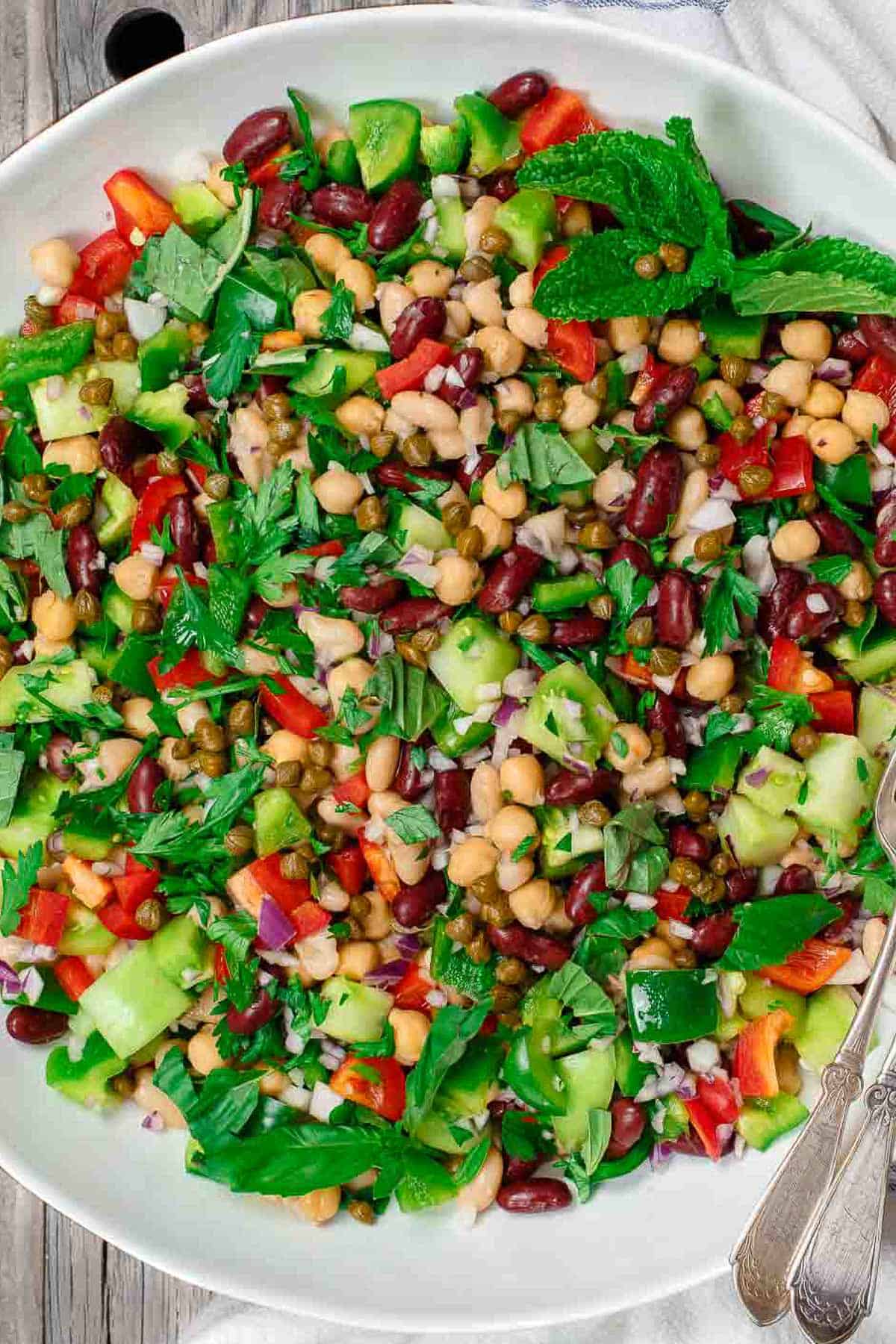
Mediterranean Three Bean Salad ToTry

Mediterranean Three Bean Salad by Suzy Karadsheh. Published: Jan 23, 2025

Easy three bean salad recipe packed with Mediterranean flavors from fresh herbs, capers, and a zesty Dijon garlic vinaigrette. Instead of mushy canned green beans, use fresh steamed ones, or swap them out for another type of bean. I chose to use cannellini beans! After dressing the bean salad, allow it to chill in the refrigerator for at least 30 minutes before serving, so that the beans can absorb the zippy dressing.

Ingredients

For the Garlic Dijon Vinaigrette

  • 2 garlic cloves, minced
  • 1/2 tablespoon Dijon mustard
  • 2 tablespoons lemon juice
  • 1 teaspoon sugar
  • 1/4 cup Early Harvest extra virgin olive oil
  • Salt
  • Freshly ground black pepper

For the Salad

  • 1 15-ounce can kidney beans
  • 1 15-ounce can cannellini beans
  • 1 15-ounce can chickpeas
  • 1 green bell pepper, cored and chopped
  • 1 red bell pepper, cored and chopped
  • 1/2 English cucumber, diced
  • 1 cup chopped red onions
  • 1 1/2 tablespoons drained capers
  • 1 cup chopped fresh parsley
  • 10-15 fresh mint leaves, torn or gently chopped
  • 10-15 fresh basil leaves, torn or gently chopped

Instructions

  • Make the Garlic Dijon Vinaigrette. In a serving bowl large enough for the salad, add garlic, mustard, lemon juice, sugar, extra virgin olive oil, and a big pinch each of salt and freshly ground black pepper. Whisk vigorously to combine.
  • Prepare the beans. Drain and rinse the canned beans. Add to the bowl with the vinaigrette.
  • Prepare the vegetables. To the bowl with the beans, add green bell pepper, red bell pepper, cucumber, red onion, capers, parsley, mint, and basil. Toss to coat in the vinaigrette.
  • Chill. For best results, cover and refrigerate for at least 30 minutes before serving so that beans soak up the vinaigrette flavors. Give the salad another quick toss before serving.

Chili Texas Style

This post is a chronology of the recipes since 2021, as we have tweaked them. The 2026 recipe is the most authentic, using whole dried chili peppers.

1/17/2026 – Mary made a great chili using the ingredients from 2/18/2019 below, except that she roasted three whole dried Ancho and three dried Quajillo peppers in a hot cast-iron skillet. Added water to cover and simmered for about 30 minutes, then drained. Then blended the peppers with all the other spices. That blend was then added to the browned ground meat with the onions, garlic, and beef stock. Chef Billy used those peppers prepared that way in his Chicken Pozole recipe.

Continue reading

Thin Chops with Billy’s Herb Butter

1/8/2026 – The simple, thin pork chops were very good and made a great meal served with Billy’s sauteed green beans. Need to make more of the herb butter to try with other meats.

This cook generally followed Billy’s Pan-Fried Pork Chop recipe but relied on the herbs and seasoning in his Herb Butter Sauce to provide the flavoring that his pork chop recipe added individually. She did not add the simple syrup he called for.

Mary quickly fried 1/2-inch thick bone-in pork chops that had been dry-brined for maybe 3 hours. Before frying she seasoned them generously with fresh ground black pepper. Once they were rare she pulled them and generously slathered on Billy’s Herb Butter Sauce left over from the NY Strip roast on 12/28/2025. The recipe for the butter is:

  • 1 stick softened unsalted butter
  • ~¼ cup finely minced fresh rosemary
  • ~¼ cup finely minced fresh thyme
  • ¼ Cup dry chives
  • 1 zested medium garlic clove
  • zest from and juice of ½ lemon
  • 1 tablespoon dry sherry red wine

Ladolemono Greek Salad Dressing

This is a great versatile dressing/marinate by Suzy Karadsheh here. Mary began making it in 2025.

You’ll love this versatile Greek lemon and olive oil dressing. You can use it as a Greek salad dressing on your favorite salad, as a marinade for chicken or fish, or as a bright finishing sauce to drizzle on things from grilled vegetables to kabobs and more!

Ingredients
  • ¼ cup fresh lemon juice, juice of 2 large lemons
  • 1 to 2 teaspoons dried oregano
  • 1 large garlic clove minced
  • ¾ teaspoon kosher salt
  • ¾ teaspoon black pepper
  • ¾ cup extra virgin olive oil
Instructions
  • Put the lemon juice, oregano, garlic, salt and pepper in a bowl. Whisk to combine.
  • While you are whisking vigorously, slowly drizzle in the extra virgin olive oil.
Notes
  • Storage: Store your ladolemono Greek dressing in a tight-lid glass jar in the fridge for up to 2 weeks (I try to use mine within 1 week). The oil will separate from the lemon as it sits in the fridge, give it a gentle shake before using on your salads, grilled meats, fish etc. 
  • Visit her online shop to browse quality Mediterranean ingredients including extra virgin olive oils and spices. 

New York Strip Roast

12/28/2025 – We bought a ~3.5 lb NY Strip Roast at Publix and dry-brined it 2 days ago. Roughly followed Billy Parisi’s recipe here. This New York strip roast was dry-brined, reverse-seared, and coated in an incredibly flavorful herb butter. This was a GREAT roast and will be made many more times.

Servings: 6 people

Ingredients 

  • 3.5 pound trimmed New York Strip roast – Dry-brine for 2 days and scored through the fat cap diagonally
  • Day of the Cook:
  • Add to the roast a lot of fresh ground black pepper
  • Herb Butter “Sauce”
    • 1 stick softened unsalted butter
    • ~¼ cup finely minced fresh rosemary
    • ~¼ cup finely minced thyme
    • ¼ Cup dry chives
    • 1 zested medium garlic clove
    • zest from and juice of ½ lemon
    • 1 tablespoon dry sherry red wine

Instructions

  • Two Days Ahead – Trim the roast of loose ends, keeping about a ½” fat cap on the top.
  • Cook Day;
  • Using your knife, score the fat cap diagonally through the fat cap and about 3/4-inch apart.
  • Next, truss the beef roast using butcher’s twine.
  • Generously season all sides with fresh ground black pepper. (Note: there was a lot of salt added for the dry brine)
  • Put the roast on the rack in the fridge uncovered for 12 to 48 hours.
  • In the meantime, whip the room temp 1 stick of softened butter in a stand mixer with the paddle attachment on high for 5 to 7 minutes or until it becomes light and fluffy.
  • Stop the mixer and add the parsley, thyme, rosemary, chives, garlic, lemon zest, juice, salt, pepper, and sherry dry red wine. Mix on low speed to combine.
  • Spread half of the herb butter onto the top of the fat cap of the roast and spread it out using a rubber spatula until it is coated.
  • Place the oven themp probe from the top into the center of the roast and reverse sear it on a middle rack in the oven at 225° with the probe set for 110° internally (which Billy says takes about 2 ½ hours for his wide flat roast as opposed to our 5″ wide and 6″ tall roast.)
  • Remove the roast, cover it with foil, and let it rest for 60 to 75 minutes.
  • While waiting, turn the heat up to 500°.
  • Did not do this:
    • You can next optionally coat the beef shank bones in oil, salt, and pepper, and roast on a sheet tray lined with parchment paper and roast in the oven on a middle rack for 20 to 25 minutes or until the marrow is 145° internally.
    • Let the bones cool slightly before adding the marrow to a food processor along with the remaining herb butter. Pulse it until it is finely minced and combined with the butter. Set it aside.
  • Once the roast has rested and the oven is on the higher setting, place it back in the oven on a middle rack at 500° until it reaches 118° to 120° for rare to medium-rare, which takes about 25 minutes.
  • Remove the roast and spread on a few tablespoons of the herb butter. Slice and serve.

Billy’s Notes

To make my New York Strip Roast turn out perfectly juicy and tender, I always account for carryover cooking. I pull the roast 2 to 5 degrees before my target temperature, cover it with foil, and let it rest so the heat gently finishes the cooking.

  • Maillard Reaction: When beef is heated to 285°-350°F, the sugar and amino acids react, creating that beautiful brown crust that adds incredible flavor and crispness.
  • Reverse Sear Method: I slow-cook the beef at a low temperature, let it rest, and then sear it at high heat for a perfect crust. This method also works great for chicken and pork! THIS WORKED.
  • Cooking Temperatures: For rare, remove the steak from the oven at 115° to 120°; for medium, 125° to 130°; for medium-well, 135° to 140°; and well-done, 140° to 150°.
  • Resting & Myoglobin: When the meat rests, the myoglobin, the protein responsible for making meat red, will rush back through the beef. I’m just telling you this because it may take a little while for this to occur. If you slice it and it looks medium to well-done, give it a few seconds, as the red and pink colors will come back through.
  • Dry Brining for More Flavor: The longer the dry brine, the more flavorful it will become.
  • Resting Between Cooks: When reversing searing meat, a good rule of thumb is to let it rest for half the time as the initial cook. This rest will take place between the first and second cook. There is no need to rest the roast after the second cook.